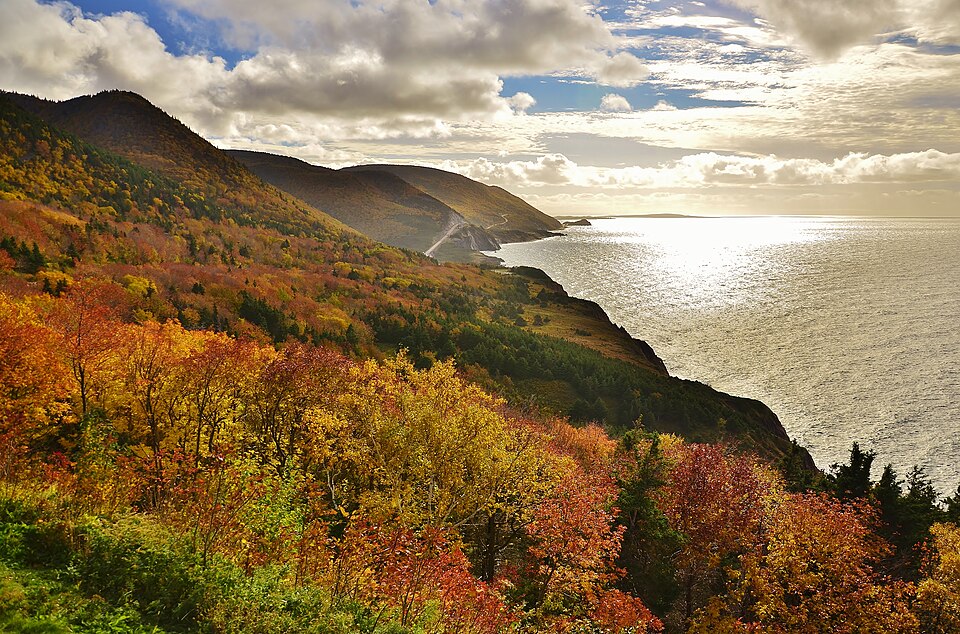
Drive north from Margaree and something changes. The place names go from Scottish to French — Belle Côte, Terre Noire, Saint-Joseph-du-Moine — the radio starts speaking a French you won't recognize from your school textbooks, and then you come around a bend and there's Chéticamp: a long ribbon of brightly painted houses strung between a green mountain wall and a silver harbour, with an enormous silver-steepled church anchoring the middle of it.
This is Acadian Cape Breton. And behind the postcard is one of the most remarkable survival stories in North America.
Why there are French speakers here at all
The short version, because your kids will ask, and because it's the key to the whole village.
The Acadians were French settlers who from 1604 built farms around the Bay of Fundy on drained salt marshes, using ingenious dyke systems called aboiteaux. Over five generations they became something distinct from France — a people who called themselves Acadians, allied with the Mi'kmaq, intermarried with them, and repeatedly refused to swear an unconditional oath of loyalty to the British Crown while insisting they wouldn't fight anyone either.
In 1755, the British began deporting them. The Grand Dérangement — the Great Upheaval — scattered roughly ten thousand people. Families were separated at the wharf. Villages were burned. Ships carried them to the American colonies, to England, to France, to the Caribbean. Some went to Louisiana, where the word Acadien became Cajun. Thousands died of disease, shipwreck and exposure.
And then, when the deportations ended, they came back.
They couldn't reclaim the Fundy marshlands — those had been given to New England settlers. So they took the land nobody wanted: rocky, exposed, hard coastline. By 1785 Chéticamp had a parish of its own. The village honours its founders as "Les Quatorze Vieux", the Fourteen Old Ones, and many families here trace their descent from them.
Two hundred and forty years later, Chéticamp is still French-speaking, still Catholic, still fishing, and still here. When you see the Acadian flag flying — the French tricolour with a single gold star in the blue — that star is the Stella Maris, star of the sea, adopted in 1884. It is a flag for a nation without a country, and in Chéticamp it flies from many houses.
Say bonjour. It costs nothing and it means a lot.
The hooked rugs, and the woman who made them famous
Walk into Les Trois Pignons on the Cabot Trail at the north end of the village and you'll find something you weren't expecting to care about: a museum of rugs.
Stay with it.
Rug hooking began here as poverty craft. Women pulled loops of wool through burlap feed sacks to make floor coverings, using whatever they had, dyed with whatever they could find. It kept the cold out of a house. By the early twentieth century, Chéticamp's hookers had turned it into a genuine folk art. In the late 1920s an American designer, Lillian Burke, working with Alexander Graham Bell's daughters, began marketing Chéticamp rugs to New York decorators, and a cottage industry was born that put cash into a village that had very little.
And then there was Élizabeth LeFort (1914–2005).
Born in Chéticamp, LeFort turned rug hooking into portraiture. Her tapestry portraits, each worked in many thousands of wool loops, were exhibited around the world, and according to Les Trois Pignons her work hangs in Buckingham Palace, the Vatican and the White House. She was made a Member of the Order of Canada in 1987. A gallery at Les Trois Pignons is devoted to her work.
Why kids like it more than you'd guess: the sheer scale. Standing a metre from a full-size hooked portrait and realizing the whole thing is made of loops of wool, one at a time, is a genuinely good moment. Les Trois Pignons also holds the village's genealogy centre and antiquities collection — if you have any Acadian ancestry, this is where you find out.
Along the main road you'll find working studios and co-ops where you can watch hooking being done and buy directly from the maker. A small hooked mat makes a lovely souvenir.
Whales
Chéticamp harbour is a popular place to see whales, and the boats know where to go.
Operators run out of the harbour from roughly mid-May to mid-October, typically two-to-three-hour trips, with July to September the most reliable. What you might see: pilot whales (the local favourite), minke whales, fin whales, humpbacks, plus seals, porpoises and, if the day is being generous, bald eagles along the cliffs.
Family tips: ask for a morning departure if there is one, as the Gulf is often calmer before the afternoon wind. Take motion sickness precautions before you board, not after. Bring far more layers than seems reasonable; it is much colder ten minutes offshore than it is on the wharf. Some operators advertise a sighting guarantee, so ask what is covered.
If someone in the family really can't do boats, the park's coastal lookouts north of the village are worth a stop, and whales can sometimes be spotted from shore.
The other things to do
Enter the national park here. Chéticamp holds the western gate of Cape Breton Highlands National Park, and the western side is the dramatic one — French Mountain, the Skyline Trail, the road carved into cliff faces above the Gulf. The park's Chéticamp Visitor Centre is at the edge of the village.
Le Buttereau trail. Just inside the park, a 1.6 km loop through an old Acadian farming settlement, with foundations and open fields still visible. Families farmed here before the park was created. It's a gentle, short walk with a genuine story attached.
Saint-Pierre Church. The great silver-steepled church built in 1893 dominates the village. The stone came from Chéticamp Island, and parishioners hauled it across the harbour ice.
Chéticamp Island and the beaches. A short causeway leads to the island, with sandy beaches, a small lighthouse and grassland walking. The water on this side is Gulf water — warmer than the Atlantic side of the island.
Eat. This is the place for fricot (a chicken and potato stew that is Acadian comfort food), fresh snow crab and lobster in season, and pets de sœur — cinnamon pastry rolls whose name translates, delightfully for any eight-year-old, as "nun's farts". Order them. Say the name. It's a rite of passage.
Hear the music. Acadian Cape Breton has its own fiddle tradition, distinct from the Scottish style you'll hear on the Ceilidh Trail — faster, with different ornamentation and a foot-percussion drive. Summer ceilidhs and community suppers happen weekly; the village visitor centre will tell you what's on.
A note on culture, said plainly
Chéticamp is not a heritage attraction. It's a working village where a language and a culture survived an attempt to erase them, and the people you meet in the shop are living in it, not performing it.
A few small things that make you a better visitor: greet people in French even if that's all the French you have. Don't ask people to "do the accent." Understand that Acadian and Québécois are different peoples with different histories — conflating them is a small insult that lands. And if you're here on 15 August, you've hit National Acadian Day and the tintamarre: a joyful, deliberately deafening parade where everyone bangs pots, rings bells and blows horns through the streets to announce that the Acadians are still here. Children are the natural constituency for a festival based entirely on making as much noise as possible. Bring a saucepan.
Practical planning
Getting there from Baddeck: about 1 hour 35 minutes via Highway 105 to Nyanza, then the Cabot Trail through Middle River and the Margaree Valley. The Margaree stretch is beautiful in its own right — allow time to stop.
When to go: July and August for whale trips, full opening hours and festivals; September for quieter boats and warm water; 8–16 October 2027 for Celtic Colours, which runs concerts in communities across the island (the 2027 line-up wasn't out when we wrote this).
Fuel: fill up in Chéticamp before entering the national park. There are no services on the plateau.
Language: everyone in the tourism trade speaks English. The French you hear between locals is Acadian French, with vocabulary and rhythms of its own — if you have school French, you'll catch about half, and that's normal.
Combining it: Chéticamp plus the western Highlands makes a long, rewarding day out from Baddeck. Add the Skyline Trail only if you've booked your parking slot in advance.
Keep exploring: Cape Breton Highlands with kids · The Cabot Trail guide · Gaelic, Mi’kmaw and Acadian culture · Drive times from Baddeck
Frequently asked questions
What is Chéticamp known for?
Acadian French culture, its hooked rug tradition, whale watching, and being the western gateway to Cape Breton Highlands National Park.
Do people still speak French in Chéticamp?
Yes — it's one of the strongest Acadian French-speaking communities in Nova Scotia, with its own distinct dialect. Everyone in tourism also speaks English.
When is the best time for whale watching in Chéticamp?
Boats run from roughly mid-May to mid-October, with July to September the most reliable months. Morning departures are often calmer. Pilot whales are commonly seen.
Is Les Trois Pignons worth visiting with children?
Yes, and it surprises people. The scale of the hooked tapestries, including Élizabeth LeFort's portraits, which have been shown around the world, lands well with children once they realize the whole picture is made of individual loops of wool.
What's the difference between Acadians and Québécois?
Both are French-speaking peoples in Canada, but they have separate origins, histories and dialects. Acadians settled the Maritimes from 1604 and were deported by the British from 1755; Québécois descend from the settlement of the St. Lawrence valley. They are not interchangeable.
How far is Chéticamp from Baddeck?
About 1 hour 35 minutes by car, a long but rewarding day trip, especially combined with the western side of the national park.