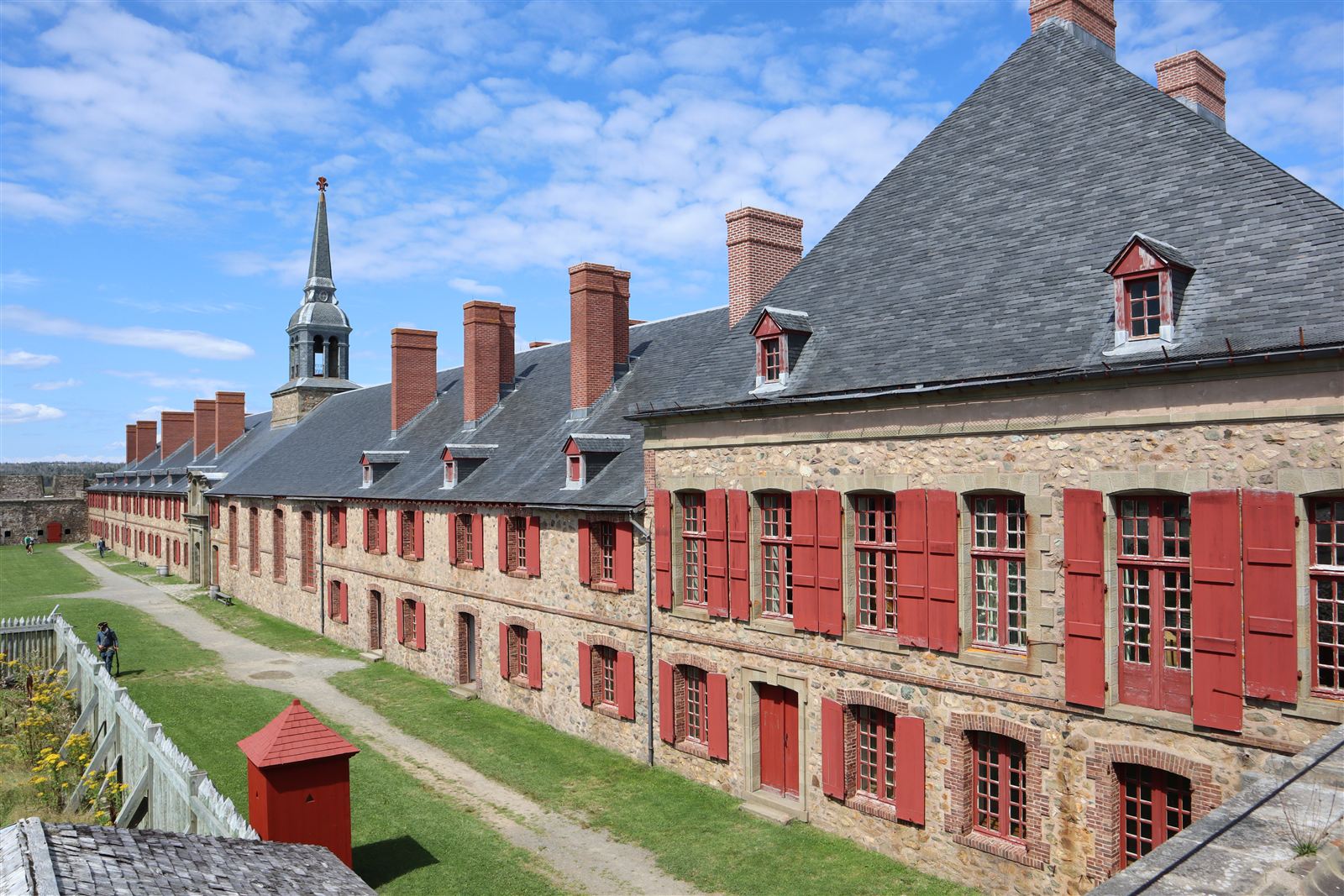
You approach it the way everyone did in 1744: on foot, across open ground, with a walled town rising out of the fog ahead and no idea what’s inside.
At the Dauphin Gate, a soldier in a grey-white coat stops you and asks your business. He will not, under any circumstances, admit that it is 2026. Play along, and your children will spend the next four hours completely convinced.
The Fortress of Louisbourg is the largest historical reconstruction in North America, and the best day out on Cape Breton Island for anyone from about four to ninety. But the reason it exists at all is a story most visitors never hear, and it’s arguably better than the sieges.
The short, dramatic life of Louisbourg
In 1713, the Treaty of Utrecht gave mainland Nova Scotia to Britain. France kept two islands: Île Royale (Cape Breton) and Île Saint-Jean (Prince Edward Island). It needed a new Atlantic stronghold, somewhere to guard the approach to the St. Lawrence and protect the thing that really mattered, which was fish.
Not gold. Not fur. Cod. The North Atlantic cod fishery was worth more to France than its fur trade.
So France built Louisbourg on a bleak, foggy stretch of coast, and within a few decades it was one of the busiest seaports in North America. There were fishing crews from Normandy and Brittany, merchants trading with Bordeaux and the West Indies, Basque coopers, Irish servants, Swiss soldiers of the Karrer Regiment, and a garrison that was often unhappy and always underpaid. Sugar and rum came north. Salt cod went south, much of it to feed enslaved workers on Caribbean plantations. Louisbourg was a hub of an Atlantic economy, not a lonely outpost.
The fortifications, meanwhile, were a very expensive disappointment. The defences facing the sea were formidable. The landward side sat on low, boggy ground overlooked by hills. Louis XV is said to have joked that the walls cost so much he expected to see them rising over the horizon from Versailles. It’s probably a legend, but a telling one.
It fell twice.
In 1745, a force of New England militia (farmers, fishermen and shopkeepers from Massachusetts under William Pepperrell, backed by the Royal Navy) landed, dragged cannon across the marsh, and besieged the town for about seven weeks until it surrendered. New England was jubilant. Then the 1748 Treaty of Aix-la-Chapelle handed Louisbourg back to France in exchange for Madras in India. New Englanders were furious.
In 1758, the British came again, this time in overwhelming force: more than 150 ships under Admiral Boscawen, with Jeffery Amherst and James Wolfe commanding the army. After a landing at Kennington Cove and a siege of about seven weeks, Louisbourg fell for the last time. Its French inhabitants were shipped back to France, and the next year Wolfe used the harbour as a staging point for the attack on Quebec.
Then, in 1760, on direct orders from London, British engineers blew up the fortifications so that no future treaty could ever hand them back. Over the following years, much of the cut stone was carted off for buildings elsewhere. Grass grew over the rest. For two hundred years, Louisbourg was a field with lumps in it.
The part nobody expects: it was rebuilt by coal miners
Here’s the twist.
By the late 1950s, Cape Breton’s coal industry was collapsing. Pits were closing across the island’s industrial east, and thousands of miners were out of work. In 1961, the federal government announced an extraordinary response: it would rebuild about a quarter of the town of Louisbourg as it stood in the 1740s, and it would hire out-of-work miners to do it.
Miners retrained as stonemasons, carpenters, blacksmiths and plasterers. Archaeologists dug the site, while historians in French archives worked through mountains of original documents: property records, court cases, inventories of dead people’s belongings, and letters home complaining about the weather. Louisbourg was a very bureaucratic colony, and bureaucracy leaves paper. As a result, few historic sites anywhere are documented this well. The researchers know whose house it was, what was in it, and often what it looked like down to the details.
So when you walk through the Dauphin Gate, you’re walking through a French colonial town rebuilt, stone by stone, by twentieth-century Cape Breton coal miners who needed the work. Tell your children that. It changes how they see everything else.
What to do with children, in order
1. Get stopped at the gate. Don’t skip the sentry. Play along.
2. Watch the guns. Through the summer there are military drills and cannon and musket firing demonstrations throughout the day. They’re extremely loud, so warn small children and cover their ears. Then watch their faces. Teenagers can sign up to fire a musket after a soldier’s basic training. Over-16s can even fire a real cannon. Both are extra-cost experiences.
3. Eat like it’s 1744. The site’s period restaurant serves 18th-century-style food. Order the simple soldier’s meal and you may find you get a spoon and no fork. The King’s Bakery sells Louisbourg’s soldier’s bread, baked fresh every day. Kids remember the meal longer than the ramparts.
4. Turn it into a game. Parks Canada’s Club Parka has self-guided discovery activities for young children, and the site runs family experiences like Secret Mission and Louisbrick. Ask at the visitor centre what’s on that day. Look out too for “Fun on the Quay,” where costumed interpreters lead 18th-century music, dance and games.
5. Find the Mi’kmaw demonstration. In season there’s a free daily Mi’kmaw culture and history demonstration (check the day’s schedule for the time). This matters. The French alliance with the Mi’kmaq was central to everything that happened here, militarily, diplomatically and economically, and the Mi’kmaq were sovereign allies, not helpers. It’s also the part of the visit that connects to a living nation today rather than a vanished town.
6. Ask the hard questions. Louisbourg’s interpreters are used to handling difficult history honestly, and children ask the best questions. Enslaved people, both Black and Indigenous, lived and worked in Louisbourg: well over two hundred across the town’s lifetime. Marie Marguerite Rose was born around 1717 in Guinea in West Africa and enslaved in Louisbourg for nineteen years. After she was freed in 1755, she married a Mi’kmaw man, Jean-Baptiste Laurent, and the two ran their own inn and tavern in the town. She is recognised as a person of national historic significance in Canada, and her story belongs in the visit as much as the cannon do.
7. Walk the Lighthouse Trail. Across the harbour, outside the fortress and free, a coastal path starts at the site of Canada’s first lighthouse (1734) and has a great view back to the fortress walls. It’s about 2 km, easy, dramatic, and excellent for burning off leftover energy.
8. See where the British landed. Kennington Cove, where Wolfe’s troops came ashore in 1758, is now one of the site’s beaches. It’s beautiful and cold, with picnic tables and outhouses, but it’s unsupervised and can have rip currents. Paddle and explore rather than swim properly.
Practical planning
Getting there from Baddeck: about 1 hour 30 minutes, along Highway 105 and then Route 22 through Sydney. Make it a full day.
Seasons and hours (2026):
- Peak season, July 1 to September 11: open daily, 9:30 am–5 pm.
- Shoulder season, May 18 to June 30 and September 12 to October 31: open daily, 9:30 am–5 pm, with fewer services and interpreters but several buildings and exhibits open.
- Low season, November 1, 2026 to May 17, 2027: the grounds are free to walk Monday to Friday, 9:30 am–4 pm. Buildings are closed and there are no interpreters.
Getting into the town: from June 19 to September 11, you park at the visitor centre and take a bus to the gate. The last bus leaves at 4:30 pm, so arriving at 4 pm gets you almost nothing. Get there by 10 am if you can. Outside those dates, you drive in yourself through Entrance 2 and park on site.
Time needed: four hours minimum. A full day is better and very doable.
Admission: standard Parks Canada fees, with youth 17 and under free year-round. (The 2026 Canada Strong Pass made admission free for everyone from June 19 to September 7. Regular fees have applied since September 8.)
What to wear: Louisbourg sits on an exposed Atlantic headland and makes its own weather. It’s often noticeably colder, windier and foggier than Baddeck. Bring layers, a windproof jacket and proper shoes. The streets are packed earth and cobble, and strollers struggle.
Food: eat at the period restaurant inside the walls; it’s part of the experience. There’s also a café for coffee and pastries, and a tavern serving local beer and rum for the grown-ups.
Frequently asked questions
How long do you need at the Fortress of Louisbourg?
Four hours at the very least, and a full day is better. Arrive by mid-morning: in summer, the last bus to the reconstructed town leaves the visitor centre at 4:30 pm.
Is Louisbourg good for young children?
Very. Costumed interpreters talk directly with children, there are Club Parka activities and family games, and there are drills, music and cannon fire. Warn under-fives about the noise of the cannon and musket demonstrations.
Is the Fortress of Louisbourg a real fortress or a replica?
Both. It’s a genuine 18th-century site: the original town stood here from 1713 until the British demolished its fortifications in 1760. About a quarter of it was rebuilt from 1961 onward on the original foundations, using archival records and archaeology.
Who rebuilt the Fortress of Louisbourg?
Mostly unemployed Cape Breton coal miners, retrained as masons, carpenters and blacksmiths. It was a federal job-creation project, begun in 1961 as the coal industry declined.
Why was Louisbourg built there in the first place?
To protect France’s Atlantic cod fishery and guard the sea approach to the St. Lawrence and Quebec, after France lost mainland Nova Scotia in 1713.
How far is Louisbourg from Baddeck?
About 90 minutes by car, an easy day trip.
Is there anything free to do in Louisbourg?
Yes. There’s the Louisbourg Lighthouse Trail at the site of Canada’s first lighthouse (1734), and the Kennington Cove beach (unsupervised). From November to mid-May, the fortress grounds are open free for self-guided walks on weekdays.