Everyone drives north. The Cabot Trail pulls traffic up the west coast and around the top of the island, and the whole southern shore — the bottom of the Bras d'Or, the canal, the Acadian islands beyond it — gets left alone.
Which is exactly why you should go.
Southern Cape Breton is the quiet quarter: warm shallow water, small museums, near-empty beaches, and one piece of engineering that children find unexpectedly mesmerising. It's also a spot people have been crossing for thousands of years, because geography made it unavoidable.
The isthmus that everybody had to cross
Look at a map of Cape Breton and find the narrow neck of land at St. Peter's, between the Atlantic and the bottom of the Bras d'Or Lake. It is about 800 metres wide.
On one side: the open ocean. On the other: an inland sea that reaches almost the whole length of the island.
For thousands of years, the Mi'kmaq portaged canoes across that neck, turning a long and dangerous sea voyage around the coast into a short walk. It was a highway junction long before anyone built a road.
In 1650, the French trader Nicolas Denys established a post here he called Saint-Pierre, trading fish and fur and building a small fort. The crossing became known as the haulover, and small boats were hauled across it overland. After the French left, the British kept using it. Everybody used it. It was the door between two worlds.
Finally, in 1854, they started to dig.
The canal: engineering a child can actually watch work
The St. Peters Canal, completed in 1869 after fifteen years of work, cuts across the isthmus. It's about 800 metres long, and it's the only working national historic canal in Atlantic Canada.
The problem the engineers faced is a nice one to explain to kids: the Atlantic has proper tides. The Bras d'Or barely does. So the water on either side of the canal is often at different heights, and which side is higher changes with the tide. The difference can reach about 1.4 metres. The lock therefore has to work in both directions — a tidal lock, filling or emptying depending on which way the water happens to be leaning that afternoon.
Sit on the grass by the lock in summer and watch a yacht come through. The gates close. The water rises or falls. The boat goes up or down. Someone waves. It takes a little while, and children watch the whole thing without being asked to.
The site is a National Historic Site, free to walk, with parking, picnic space and interpretive panels. Locks operate roughly mid-May to mid-October. Add a picnic and you have a very easy, very pretty couple of hours.
Battery Provincial Park
Right beside the canal, on the headland above it, Battery Provincial Park takes its name from the batteries that once guarded this crossing. The French fort here was Fort Toulouse, and the site later had British defences. Earthworks are still visible in places.
Today it's a campground and day-use park with walking trails, picnic tables and outstanding views over St. Peters Bay and the canal. It's a lovely picnic spot, and the trails are short enough for small children.
The photographer who made the Bluenose famous
Here's a small, lovely piece of Nova Scotia trivia hiding in this village.
Wallace MacAskill (1887–1956) was born in St. Peter's and became the great marine photographer of the age. His images of schooners under sail — above all his portraits of the Bluenose, the racing schooner on the Canadian dime — defined how the world pictures Nova Scotia. If you have ever seen a sepia photograph of a tall ship heeled over in a gale off this coast, you have probably seen a MacAskill.
The MacAskill House Museum, in the house where he was born, displays his photographs and his story. It's small and takes about half an hour, but pull a Canadian ten-cent coin out of your pocket first, show the kids the ship on it, and the visit lands.
Over the causeway to Isle Madame
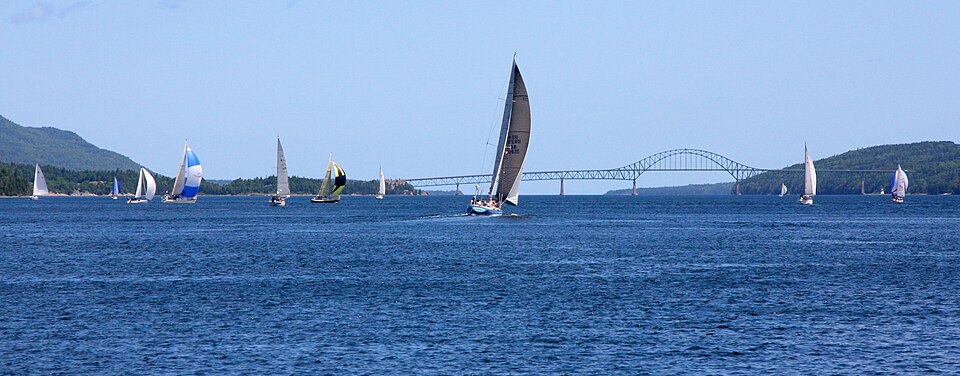
About 35 minutes beyond St. Peter's, a bridge carries you onto Isle Madame — a cluster of islands that is one of the oldest Acadian settlements in Cape Breton and feels, immediately, like somewhere else.
Arichat is the main village, and it was once a genuinely important place. In the 1700s and 1800s, Jersey merchant houses — above all Robin, Jones & Whitman — ran the salt cod trade from here, shipping Cape Breton fish to the Mediterranean, the Caribbean and Brazil. Many fishermen were tied to the company by credit they could never quite clear.
Arichat was substantial enough to become the seat of a Catholic diocese: Notre-Dame-de-l'Assomption was the cathedral of the Diocese of Arichat, and a college founded here in 1853 later moved to Antigonish and became St. Francis Xavier University. A small fishing village with a cathedral and the beginnings of a university.
Things to do on Isle Madame with children:
LeNoir Forge Museum, Arichat. A restored stone blacksmith's shop built around 1793, one of the oldest stone buildings on Cape Breton Island, with a working forge run by volunteers. It's part of the LeNoir Landing site and is open Tuesday to Saturday in July and August, with shorter hours in June, September and October. Check before you go.
Little Anse. At the island's southeastern end, Little Anse is a working fishing village of brightly painted houses beside a rocky shore. It is one of the most photogenic corners of Cape Breton, and few visitors make the trip. Park considerately, walk the shore, and remember that people live and work here.
Pondville Beach Provincial Park. A sandy beach with a sheltered lagoon behind it, a good option for younger children. Check conditions before swimming.
Cape Auguet Eco-Trail. A coastal walking trail with big Atlantic views, seabirds and, if you're lucky, seals. Choose a shorter section with young walkers.
Petit-de-Grat. A working Acadian fishing village where French is still widely spoken and the wharf is a wharf, not a heritage display. Watch the boats come in.
A note on this coast
Two things worth carrying with you.
First, the Acadian communities of Isle Madame have the same history as Chéticamp — deportation in 1755, return afterwards, a language held onto for two hundred and fifty years — but with a different accent and a stronger flavour of the sea. It's a working place; treat it as one. Bonjour goes a long way here too.
Second, Potlotek (Chapel Island), the Mi'kmaw community nearby, holds the St. Anne's Mission each summer — one of the most important annual gatherings in Mi'kma'ki. It is a spiritual and community event, not a visitor attraction, and it should not be dropped in on. Know it's there; leave it be unless you're welcomed.
Practical planning
Getting there from Baddeck: St. Peter's is about 1 hour 45 minutes (117 km), the longest of our day trips. Your map app will route you via Highway 105 and Route 4, a quiet drive with lake views along the way. Arichat is a further 35 minutes or so.
A good day out: leave early, reach the canal and lock in late morning, picnic at Battery Provincial Park, then visit MacAskill House. Isle Madame (LeNoir Forge, Little Anse, Pondville) adds about 35 minutes each way, so treat it as a second trip, or stretch the day with an overnight stay.
When to go: June to October. The lock operates roughly mid-May to mid-October; smaller museums typically open late June to early September, so check before travelling outside high summer.
A fog-day option: the south can be clearer when fog sits on the Highlands, though it isn't guaranteed. Check the forecast for both before you commit to the long drive.
Facilities: St. Peter's village has shops, restaurants, fuel and supplies. Isle Madame is quieter — carry water and snacks.
Boating: if anyone in your family sails, the canal is a genuine bucket-list transit and the marina at St. Peter's is the gateway to cruising the whole Bras d'Or.
Keep exploring: Bras d’Or Lake · Chéticamp with kids · Cape Breton itinerary from Baddeck · Drive times from Baddeck
Frequently asked questions
What is there to do in St. Peter's, Nova Scotia?
Watch boats lock through the St. Peters Canal National Historic Site, picnic and walk at Battery Provincial Park, and visit the MacAskill House Museum and the Nicolas Denys Museum. It's an easy, uncrowded visit, though a long drive from Baddeck.
Why is there a canal at St. Peter's?
The village sits on an 800-metre neck of land between the Atlantic and the Bras d'Or Lake. The Mi'kmaq portaged canoes across it for thousands of years and Europeans hauled boats over it from the 1600s. The canal, built between 1854 and 1869, replaced the haul, and it is the only working national historic canal in Atlantic Canada.
Can you watch the lock working?
Yes. Boats transit through the season, roughly mid-May to mid-October, and the site is free to walk around with grassy banks right beside the lock. Each transit takes a short while.
Is Isle Madame worth visiting?
Yes, especially if you want the quiet side of Cape Breton — a historic stone blacksmith's forge at Arichat, the painted fishing houses of Little Anse, a sheltered beach at Pondville, and a working Acadian fishing culture with very few tourists.
Is southern Cape Breton good for young children?
Often, yes. The beaches are sheltered, the museums are small enough to hold attention, and there are few crowds, but allow for the long drive from Baddeck.
How far is St. Peter's from Baddeck?
About 1 hour 45 minutes by car, so it is the longest of our day trips, but the route is quiet.