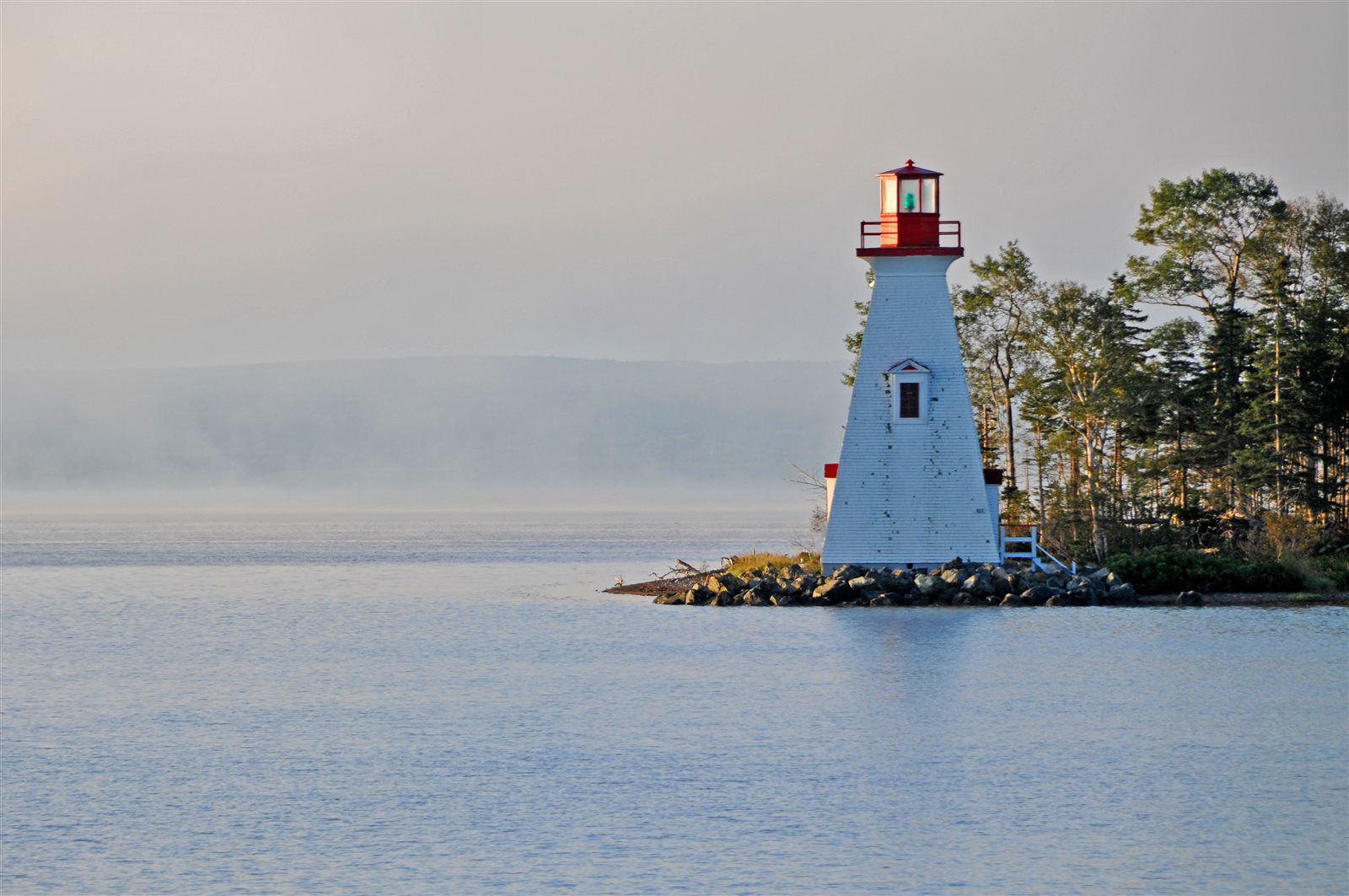
Almost every family who comes to Baddeck has the same moment. You’ve driven a long way, and someone in the back seat has asked how much further about nine hundred times. Then Highway 105 drops down the hill, the trees open out, and there it is: a wide sheet of blue water, a small white lighthouse on an island in the middle of it, and a village of clapboard houses spilling down to the shore.
The car goes quiet. That’s the moment.
Baddeck is a village of about 800 people (818 at the last census) that behaves like a small capital city. It has been the heart of Cape Breton tourism since the 1890s, it’s the official start and end of the Cabot Trail, and it sits on the edge of one of the strangest and loveliest bodies of water in the world. It’s also, and travel guides tend to forget this part, an outstandingly easy place to holiday with children. Everything is walkable. The beach has a lifeguard. The museum is built around a story kids actually like. And when it rains (this is Nova Scotia, so it will) there are enough indoor options to see you through.
Here’s how to spend your days.
First, the water: what exactly is Bras d’Or Lake?
Your kids will ask, and the answer is a good one.
Bras d’Or Lake isn’t really a lake. It’s an inland sea: a huge estuary in the middle of Cape Breton Island, joined to the Atlantic by two natural channels in the north and a canal at St. Peter’s in the south. Salt water pushes in, fresh water pours down from the rivers, and the two mix into something brackish, sheltered and unusually calm.
The Mi’kmaq, who have lived on and around this water for thousands of years, call it Pitupaq, “the long salt water.” That’s a far more accurate name than ours. The French name is an accident: maps before the 1870s labelled it Labrador, a name early Portuguese charts gave to much of this coast, and over time it blurred into Bras d’Or, which happens to mean “arm of gold” in French. A misspelling that turned into poetry.
The lake covers about 1,100 square kilometres and drops to 287 metres deep in St. Andrews Channel. In 2011 UNESCO designated its whole watershed a Biosphere Reserve, and one of the reasons makes a great dinner-table fact. In the cold, deep pockets live tiny shrimp-like creatures otherwise found only in the high Arctic. In the warm, shallow coves live oysters and other species that are rare anywhere north of Virginia. Both groups got here thousands of years ago, and the lake’s mix of deep and shallow water has kept them here ever since. That’s the Arctic and the mid-Atlantic coast in a single lake.
For a family, what matters is this: the water is warmer than the open Atlantic, it’s usually flat, and there are bald eagles everywhere. Cape Breton has one of the densest breeding populations of bald eagles in eastern North America. Sit on the wharf for twenty minutes and you’ll very likely see one.
Want the full story? Read our guide to Bras d’Or Lake, the inland sea.
Kidston Island: the free ferry your kids will remember for years
This is the best thing in Baddeck, and it costs nothing.
Kidston Island sits a few hundred metres offshore, right in front of the village. Every July and August, the Baddeck Lions Club runs a free shuttle boat from the community wharf on the waterfront, back and forth at regular intervals all day. The club has been doing it for about 75 years. You line up on the dock, climb aboard, and a couple of minutes later you’re on an island.
What you’ll find there:
- A sandy beach with a lifeguard on duty in season. It’s effectively the village swimming pool, and the shallow water warms up nicely by August.
- About 2.3 km of woodland trails, including the walk to the Kidston Island lighthouse, a white square tower with a red lantern, built in 1912. It’s the photo everyone takes home.
- Views back across to Beinn Bhreagh, the Bell estate on the headland opposite, where the village’s strangest chapter unfolded (more on that below).
Practical notes for parents: there’s no shop on the island, so bring everything you need, including water and a bag for wet swimsuits. Ask about the last crossing when you board, because you don’t want that conversation with a five-year-old at 6 pm. The ferry is seasonal, weather-dependent and run by volunteers, so check it’s running before you promise anything. Donations are welcome.
Alexander Graham Bell: the man who wouldn’t stop inventing
Most people arrive at the Alexander Graham Bell National Historic Site expecting a room about telephones. What they get is much odder and much better.
Bell first came to Baddeck in 1885 and loved it straight away. He said it reminded him of his native Scotland. He and his wife Mabel built Beinn Bhreagh (Gaelic for “beautiful mountain”) on the headland across the bay, and for the next thirty-seven years he used Cape Breton as a huge open-air laboratory. The telephone was already behind him. Everything else happened here.
He built tetrahedral kites, huge red honeycombed structures made of thousands of triangular cells, and flew them off the hills above the lake, convinced the shape was the key to flight. In 1907, with funding from Mabel, he formed the Aerial Experiment Association with four young engineers and pilots. On 23 February 1909, one of their machines, the Silver Dart, took off from the ice of Baddeck Bay and flew about half a mile. It was the first controlled powered flight in Canada and in the whole British Empire. The pilot, J.A.D. McCurdy, was a Baddeck boy who grew up in this village, which kids tend to love.
Later, in his seventies, Bell turned to boats. His HD-4 hydrofoil, a strange winged craft whose hull lifted clear of the water at speed, set a world marine speed record on Bras d’Or Lake in 1919: 70.86 miles per hour (114 km/h). The record stood for years. The museum has a full-size HD-4 and a replica of the Silver Dart, and both are enormous.
Underneath all of it is the part that gives the museum its heart: Bell’s lifelong work teaching deaf people. His mother was hard of hearing, and Mabel had been deaf since scarlet fever at age five. He always thought of himself first as a teacher of the deaf.
Visiting with children: allow at least two hours. The museum’s rooftop deck has a panoramic view across to Beinn Bhreagh. There’s the Tetra Café for coffee and baking, picnic tables on the grounds above Baddeck Bay, and a gift shop full of kites, which is a dangerous place to take a child who has just learned about kites. Ask at the desk which hands-on and kite activities are running that day. Visitors 17 and under get into all Parks Canada sites free, year-round.
Read more in Alexander Graham Bell’s Baddeck.
Getting out on the water
You’ve come to an inland sea, so get out on it.
- Sailing and boat tours leave from the Baddeck waterfront through the summer, usually two-hour afternoon or sunset trips. Some skippers will let older children take the wheel.
- Kayaks, canoes and paddleboards can be rented in the village. The bay in front of Baddeck is sheltered and fairly shallow, which makes it a good first paddle for families.
- Puffin tours to the Bird Islands leave from Englishtown and Big Bras d’Or, about 30–40 minutes’ drive away. They’re the way to see Atlantic puffins, along with razorbills, guillemots and grey seals. Puffins are only around from roughly mid-May to mid-August, so if you have a puffin-obsessed child, plan your trip around that.
Wandering the village
Chebucto Street, the main street, takes about ten minutes to walk end to end. Along it you’ll find independent shops, galleries selling work by Cape Breton makers, ice cream and chowder.
Two things worth seeking out:
The Baddeck Gathering Ceilidhs. Every evening through the season, local musicians play a ceilidh (say KAY-lee) at St. Michael’s Parish Hall, 6 Margaree Road. It runs 7:30–9:30 pm. In 2026 that’s June 13 to October 18. These aren’t staged tourist shows. They’re the real thing: fiddle and piano, tea and homemade oatcakes at the break, and quite often someone’s twelve-year-old niece step-dancing better than you ever will. Tickets are $20 for adults and $10 for children, cash only, sold at the door from 5 pm. Reserving ahead is recommended.
The waterfront boardwalk and wharf. Free, flat and stroller-friendly, with the best eagle-watching in the village. Go at golden hour.
When it rains (and it will)
Every Cape Breton trip needs a wet-weather plan. Here’s Baddeck’s:
- The Bell museum. Obviously. It fills half a day indoors.
- Wagmatcook Culture & Heritage Centre, about fifteen minutes west on Highway 105. It’s a Mi’kmaw-run centre with exhibits, a restaurant and a gift shop.
- The Gaelic College (Colaisde na Gàidhlig) at St. Ann’s, about twenty minutes north. Its Great Hall of the Clans museum tells the Highland settlement story, and you may hear Gaelic spoken as a living language.
- Board games, a bakery run, and the honest pleasure of watching weather move across a big lake from indoors.
For more on the culture behind those last few, see Three Cultures, One Island.
Practical planning
Getting here: Baddeck is on Highway 105 (the Trans-Canada) at Exits 8 and 9. It’s about an hour from Sydney’s airport (J.A. Douglas McCurdy Sydney Airport, named after the Silver Dart’s pilot) and roughly four hours from Halifax.
When to go: late June to mid-October. July and August are warmest and busiest, and the only months the Kidston ferry runs. September is the local secret: warm water, thin crowds, and most things still open. The Celtic Colours International Festival runs October 9–17, 2026, filling the island with music just as the maples turn.
Baddeck as a base: this is the case for staying put rather than changing hotels every night. From Baddeck, the Cabot Trail highlands, Louisbourg, the Ceilidh Trail, Iona and Eskasoni are all day trips. You come home each evening to the same beds, the same kitchen, and a village where you can walk to dinner. With children, not repacking the car every morning is worth more than any view.
Budget note: Baddeck’s best things (the ferry, the beach, the boardwalk, the eagles) are free.
Frequently asked questions
Is Baddeck good for young children?
Yes, unusually so. The village is compact and walkable, the Kidston Island beach is lifeguarded and shallow, and the Bell museum is built around kites, planes and boats. Nothing requires a long drive.
How many days do you need in Baddeck?
Two days covers the village itself. Five to seven days lets you use it as a base for the whole island without ever repacking.
Can you swim in Bras d’Or Lake?
Yes. It’s brackish rather than fully salty, sheltered, and noticeably warmer than the open Atlantic, at its best from mid-July through August. Kidston Island, with a lifeguard in July and August, is the obvious spot.
Is the Kidston Island ferry really free?
Yes. The Baddeck Lions Club runs it as a community service from July 1 to August 31 each year. Donations are appreciated. It’s weather-dependent, so check it’s running on the day.
How far is Baddeck from the Cabot Trail?
Zero kilometres. Baddeck is the official start and end of the Cabot Trail, so you’re on it the moment you leave the village.
What’s the best month to visit Cape Breton with family?
July and August for swimming, the Kidston ferry and full opening hours. September for warm water, quiet trails and easier bookings. The first half of October for peak colour and Celtic Colours.